Do I have to pay my nanny when I'm home?
By the maklo team · November 29, 2026 · 5 min read
If you guaranteed your nanny's hours, then yes: a day you work from home, take off, or decide you don't need care is paid exactly as scheduled. Federal law only requires you to pay for hours actually worked, so this is a promise in your agreement rather than a legal rule. It's a promise most nanny employers make, and breaking it is one of the fastest ways to lose a good nanny.
This question comes up more than any other among parents who employ a nanny. When we read six months of posts on r/NannyEmployers, 516 of 1,669 posts were about schedules and hours, including days a parent was home. The most-discussed thread in that period, at 545 comments, was a parent asking whether their nanny should still work full hours on the parent's day off.
Below: why guaranteed hours exist, how each common "I'm home today" situation is usually handled, and the clause that settles it.
Why families pay for days they're home
A full-time nanny reserves their week for you. They can't pick up another family's Wednesday because you happened to stay home, and their rent doesn't drop because your meeting got cancelled. Guaranteed hours are what you pay for that reserved time, the same way you'd pay for a daycare spot during a week your child stays home.
That's also why guaranteed pay is the norm rather than a perk. Care.com, citing the International Nanny Association's salary and benefits survey, reports that 76% of nannies receive guaranteed pay when the family doesn't need them. Payroll providers such as GTM recommend the same structure.
There is one thing guaranteed hours are not: a credit you can spend later. "Banking" the hours your nanny didn't work and asking them to make up the time another week is something GTM describes as illegal for hourly employees, because each week's hours are paid in that week.
Common situations and the usual answer
| Situation | Usual answer with guaranteed hours |
|---|---|
| You work from home and the nanny works as normal | Normal day. The nanny keeps full responsibility for the children during scheduled hours. |
| You take a day off and send the nanny home | Paid as scheduled. It was your choice. |
| You decide at 7am you don't need care today | Paid as scheduled. |
| You send the nanny home at noon because you're done with work early | Paid as scheduled. |
| The nanny asks to leave early because you're home | The nanny's request. You can say no, or agree that it's unpaid or comes from PTO. |
| Your child is sick and you stay home with them | Paid as scheduled, unless your agreement says the nanny cares for mildly sick children and the nanny chooses not to. |
| The nanny is sick | Comes from the nanny's paid sick days (and your state's sick leave law, if it has one). |
| A paid holiday falls on a work day | Paid, as a holiday. |
The pattern is simple. When the change comes from the family, the nanny is paid. When it comes from the nanny, it's unpaid time or comes out of their own paid time off.
A worked example
Say you pay $28 an hour and guarantee 50 hours a week, Monday to Friday, 8am to 6pm. Under federal law, hours over 40 in a workweek are paid at 1.5 times the regular rate (DOL Fact Sheet #23), so a normal week costs:
- 40 hours at $28 = $1,120
- 10 hours at $42 = $420
- Total: $1,540
On Friday you work from home, finish early, and send your nanny home at noon. They worked 46 hours. With guaranteed hours the week still costs $1,540. Without guaranteed hours you'd owe 40 hours at $28 plus 6 hours at $42, which is $1,372. That's $168 saved this week, at the cost of a nanny who now knows any day can be cut on short notice. (Illustrative numbers.)
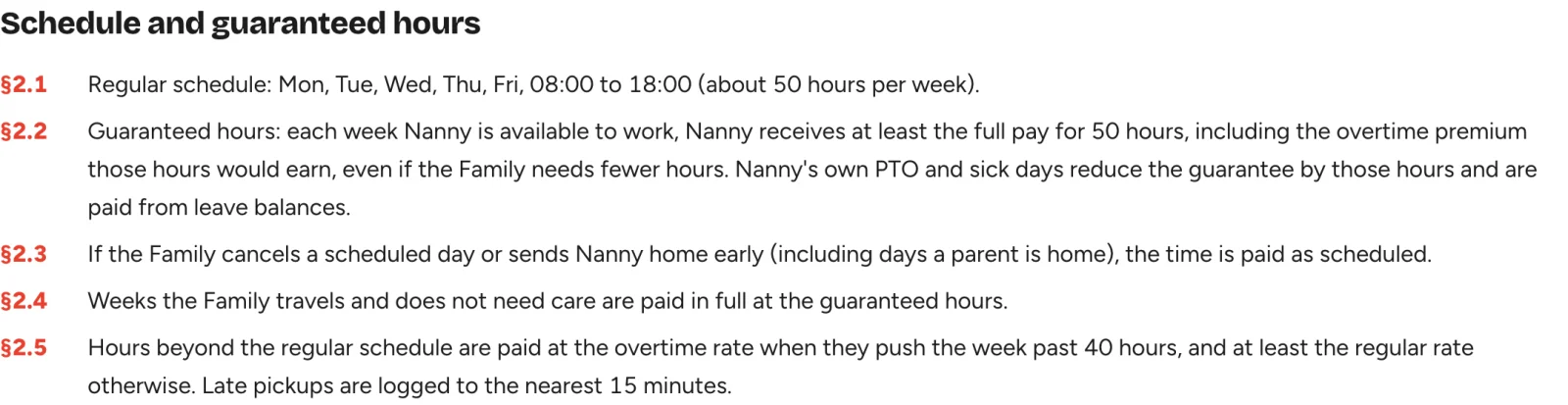 maklo writes the "parent is home" rule into the agreement as its own clause (§2.3), so the answer is settled before the day comes.
When a parent being home causes friction
Being paid isn't usually the hard part. The hard part is the day itself. Nannies on r/NannyEmployers describe children who melt down when a parent is in the next room, and parents describe nannies who hand the baby over the moment they walk into the kitchen. A few rules keep the day working for everyone:
- Say who's in charge. During scheduled hours the nanny has the children, even if you're home. If you want to step in for lunch, say so, and hand back afterward.
- Keep your work space out of the routine. A closed door helps more than any rule.
- Decide early-leave requests once. If your nanny regularly asks to leave when you're home, agree on a rule (for example: unpaid, or from PTO, with a day's notice) instead of negotiating every time.
- Don't quietly convert days to PTO. If you want some of your nanny's paid time off to land on days the family chooses, write that into the agreement up front.
If you're writing or rewriting your agreement, maklo asks about each of these and turns your answers into numbered clauses. When a situation comes up later, you can ask "is this fair?" and get an answer from your own agreement.
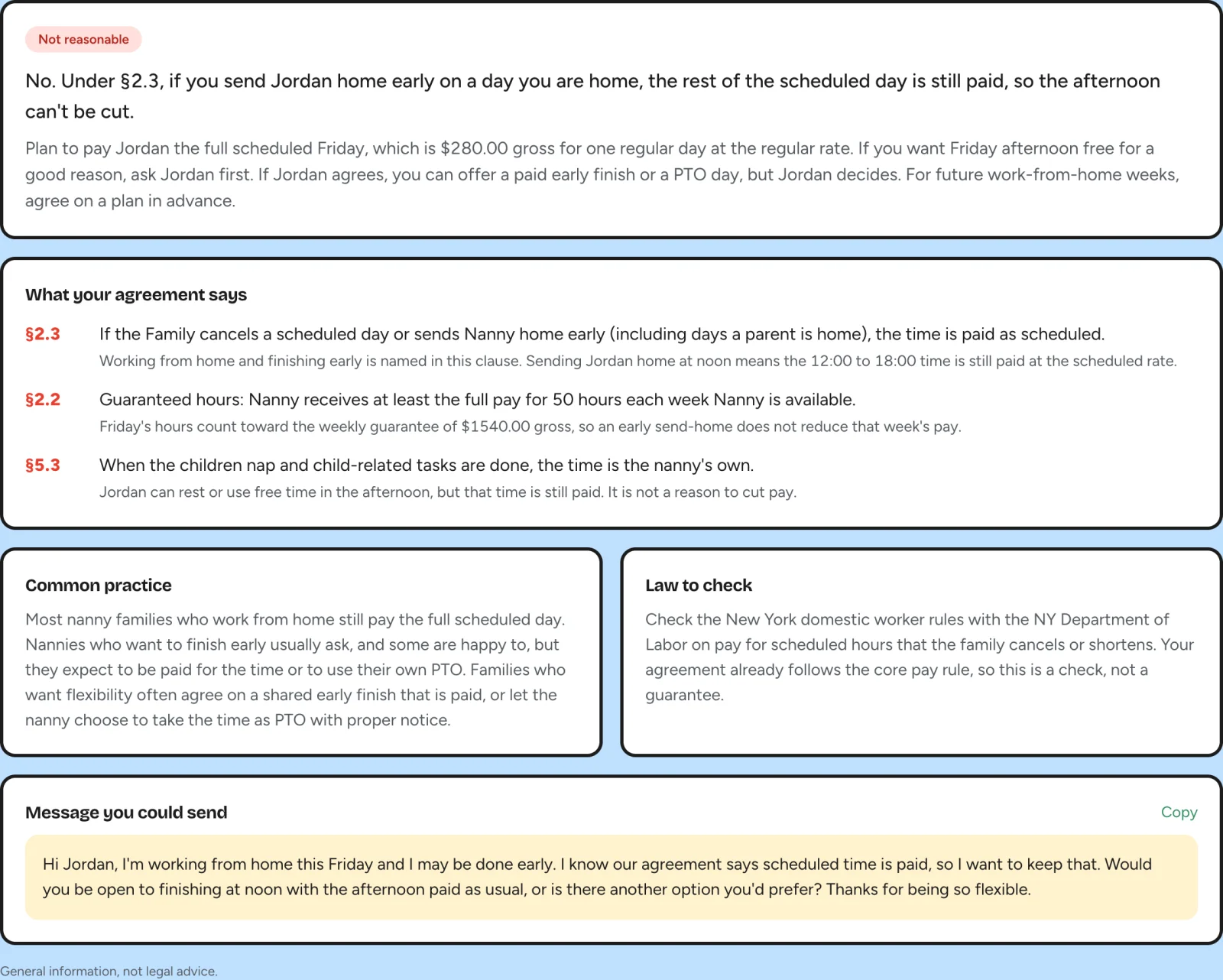 A real answer from maklo's "Is this fair?" to the question at the top of this page, read from the sample agreement.
Clause you can copy
Guaranteed hours. Each week the Nanny is available to work, the Nanny is paid for at least [50] hours, including the overtime premium those hours would earn, even if the Family needs fewer hours.
Days a parent is home. If the Family cancels a scheduled day, sends the Nanny home early, or a parent is home during scheduled hours, the time is paid as scheduled. During scheduled hours the Nanny remains responsible for the children unless a parent says otherwise.
Nanny-requested time. Time the Nanny asks to take off is unpaid unless it is taken from the Nanny's paid time off.
Adjust the numbers to your schedule. For how vacations fit in, see paying your nanny when you go on vacation; for the overtime math, see nanny overtime rules.
What the law does and doesn't say
Federal law requires minimum wage and, for nannies who live out, overtime after 40 hours in a workweek, for the hours actually worked (DOL Fact Sheet #79B covers the live-in exception). It doesn't require pay for hours you didn't need. Several states add rights for domestic workers, such as New York's day of rest and paid days off, so check your state's labor department.
Guaranteed hours, then, are a contract term. Once you've agreed to them, they're as binding as the hourly rate. If you want a different deal, change it going forward, in writing, with notice. Don't change it on the day.
This guide is general information, not legal advice.