How to split the cost of a nanny share
By the maklo team · November 29, 2026 · 3 min read
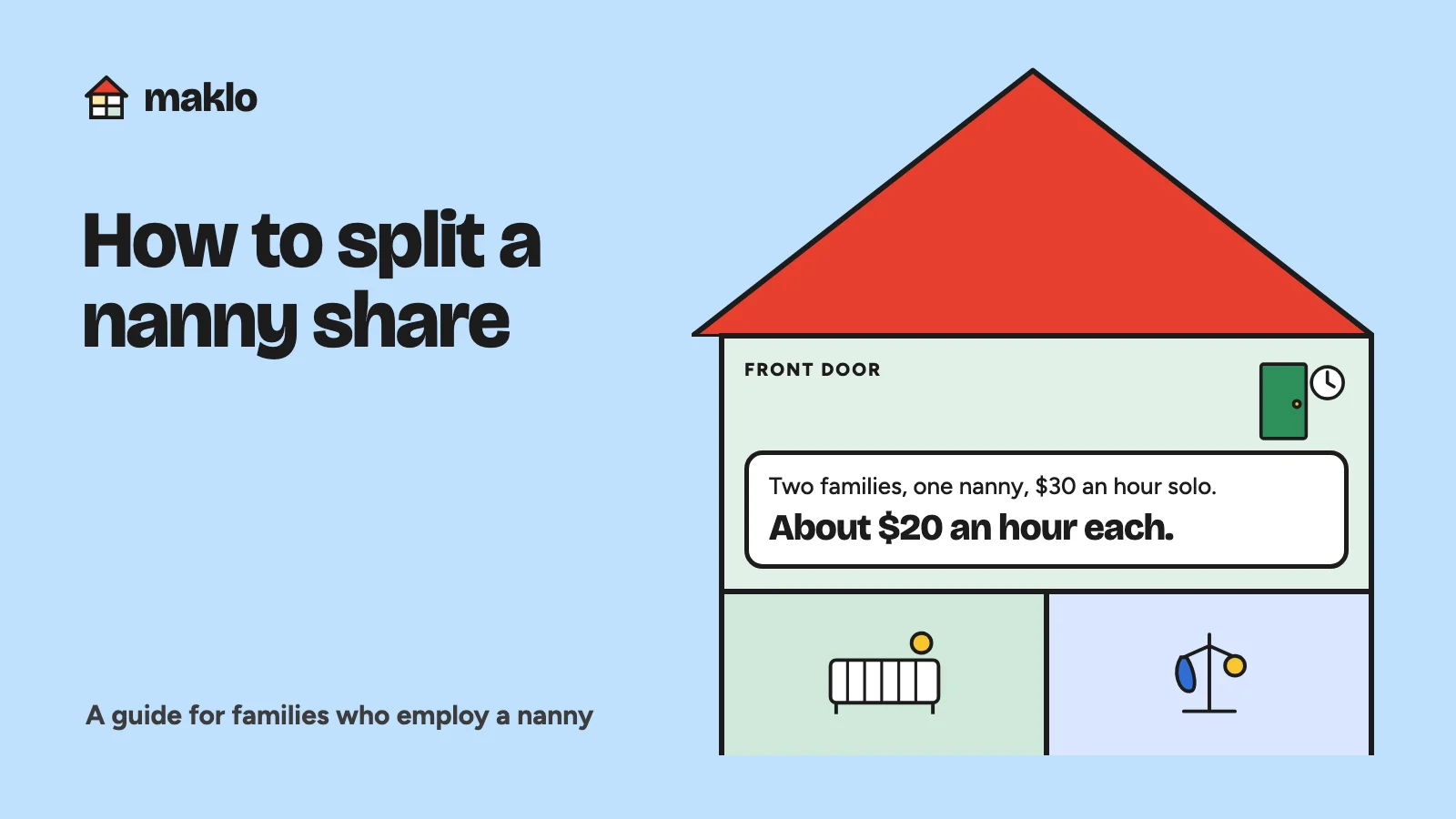
In a nanny share, each family usually pays about two-thirds of a solo nanny rate, so the nanny earns more in total and each family pays less than it would alone. Families split the pay 50/50 when each has one child and both use the same hours, or by children or hours when they don't. And each family is its own employer for taxes.
The money is the easy part. The arguments in nanny shares come from everything around it: whose house, who buys the snacks, what happens when one family goes on vacation, and who pays when the share runs late. Families in r/NannyEmployers ask these questions constantly, usually after a share is already running.
Setting the rate
Care.com's guide gives the usual starting point: a nanny who earns $30 an hour with one family costs each share family about $20, so the nanny earns $40 an hour in total. The nanny gets a raise for caring for more children; each family saves about a third.
Agree the total rate first, then the split. Talking about the total keeps everyone honest about what the nanny earns.
Splitting it
| Situation | Usual split |
|---|---|
| One child each, same hours | 50 / 50 |
| One family has two children, the other one | By children: 67 / 33 |
| One family needs extra hours alone | Shared hours 50 / 50, solo hours paid by that family |
| Different start dates or part-time weeks | By hours used |
Try your own numbers in the free nanny share calculator. It splits the wages, overtime, each family's employer taxes and the host credit.
A worked week
Two families share a nanny at $40 an hour total for 45 hours a week, live-out, split 50/50. (Illustrative numbers.)
| Total | Each family | |
|---|---|---|
| 40 regular hours × $40 | $1,600 | $800 |
| 5 overtime hours × $60 | $300 | $150 |
| Gross pay | $1,900 | $950 |
| Employer Social Security and Medicare (7.65%) | $72.68 |
Overtime runs on the nanny's total hours, not each family's half. Federal law requires time and a half for a live-out nanny's hours over 40 in a workweek, and the families split that premium the same way they split regular pay. Some states have stricter rules; see our overtime guide.
Taxes: two employers, not one
The IRS treats each family as a separate household employer, even if the nanny works in only one home. That means:
- Each family gets its own EIN and runs its own payroll for its share of the wages.
- Each pays employer Social Security and Medicare (7.65%) and federal and state unemployment tax on its share.
- Each gives the nanny a W-2 and files Schedule H with its own return.
- Each family's share should be at least the state minimum wage for every hour.
The thresholds in IRS Publication 926 apply to each family separately: in 2026, Social Security and Medicare apply once one family pays the nanny $3,000 or more. Our nanny tax guide walks through the forms.
Avoid having one family pay the nanny in full and collect from the other. It makes one family the sole employer on paper and leaves it chasing money.
The host home
The host family covers heat, wear, toys and often snacks. Common fixes:
- A weekly credit from the non-host family, often $20 to $30.
- Bring supplies: the non-host family brings its child's food, diapers and a share of the snacks.
- Rotate homes every week or month, which evens out the cost but means two homes to childproof.
Split shared gear, like a double stroller, down the middle, and agree who keeps it if the share ends.
What to agree before day one
- The total rate, the split, and the pay day.
- Guaranteed hours, and what happens when one family is away, sick, or on vacation. Most shares keep paying the nanny in full.
- Holidays, paid time off and sick days, and who covers them.
- Whether a sick child can come to the share.
- How one family leaves: notice to the other family and to the nanny. A share that ends suddenly costs the remaining family the full rate.
Put it in writing, with both families and the nanny signing. maklo's nanny agreement covers pay, guaranteed hours, time off and notice in numbered clauses, and the Is this fair? tool answers "what does our agreement say" when a question comes up.
This guide is general information, not legal or tax advice.